
Flawed Mortality Records
Why the death certificates produced under the COVID protocols cannot serve as evidence that the protocols were safe.

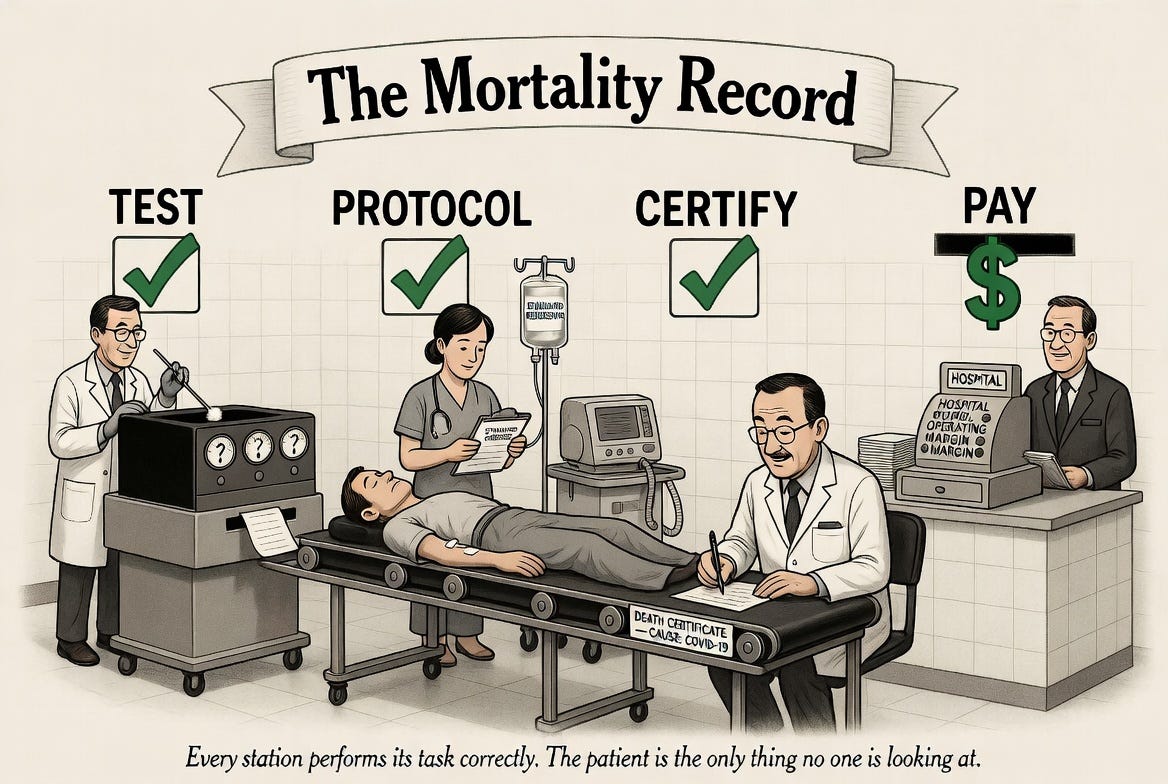
Picture the hospital. Any of them, in any month of 2020, 2021, or 2022. A patient arrives short of breath. The triage nurse swabs the nasopharynx. The swab goes to the laboratory. The instrument cycles thirty-five, forty, sometimes forty-five times before the signal crosses threshold. The chart now carries a positive code. The treating physician applies the protocol the hospital has standardized. Remdesivir on day one. Ventilation on day four. Isolation throughout. The family is forbidden from the bedside under federal guidance no one had measured against the harms isolation itself causes. The patient dies on day eleven. The same physician who applied the protocol signs the death certificate. The chart goes to the coder. The Medicare claim goes out with the COVID diagnosis present, which triggers a twenty-percent payment adjustment the hospital was relying on to close its operating-margin gap. The line item enters the national mortality file. The national mortality file becomes the evidence cited for the next round of policy.
This essay is not an estimate of how many deaths during that period were caused by the protocols rather than by the disease. The records that would tell us were produced by the system under examination. Estimating from those records is asking the suspect to grade his own testimony.
The argument is upstream of that one. Four conditions converged across the COVID period to make the mortality record structurally unreliable as evidence about what the protocols did. Each of the four was documented in peer-reviewed literature before the pandemic began. Together they make the conclusion mechanical.
I. The instruments did not diagnose disease
PCR amplifies sequence fragments. It does not measure infectious virus. Run a sample through enough cycles and the assay will return a positive signal from molecular debris, from contaminating fragments, from material the body cleared weeks earlier. Mullis, who developed the technique and received the Nobel for it, said this publicly while he was alive. The FDA’s own Emergency Use Authorization documents for the SARS-CoV-2 PCR assays acknowledged the limitation in the small print that no clinician was required to read.
Western blot does not detect antibodies. It measures protein bands by molecular weight on a gel, reported in kilodaltons. A band at a given mass is a band at a given mass — many different proteins of similar weight migrate to the same position, and the assay cannot distinguish among them. The interpretive convention that a 24-kilodalton band represents “antibody to HIV p24” or that any particular SARS-CoV-2 band represents specific viral exposure is exactly that — a convention layered on top of a mass measurement, not a chemistry that demonstrates the specificity claimed for it. I have written about the kilodalton problem at length on this Substack (1).
ELISA reads an optical signal that the assay attributes to a binding event between something in the sample and something the test was coated with. The signal does not establish, on its own, that a specific antibody to a specific pathogen is present. Cross-reactivity with prior coronavirus exposures, with other antibodies, with non-specific binding has been known in the laboratory literature for decades and was known when the assays were repurposed for COVID surveillance.
Antigen testing was added to the gateway later, with a sensitivity profile that made it useful for population screening and not useful as a clinical diagnostic. The package inserts said so. The package inserts were not part of the workflow.
None of this is new. A screening instrument designed for one purpose was converted by institutional fiat, without revalidation, into a legal trigger for medical, judicial, and reproductive consequences. The same instruments, the same technical defects, and the same conversion of laboratory artifact into clinical authority produced the same population result then that they produced for SARS-CoV-2 thirty years later.
The gateway to the mortality record was an instrument that could not, on its own technical specifications, distinguish the disease from its absence.
II. The physicians applying the protocols had not been trained to question them
The physicians who applied the COVID protocols were not lying. The vast majority of them believed the tests were valid, safe, and believed the institutional guidance reflected the best available science. Many of them still believe it. The physicians I respect — physicians I have known for decades, physicians who provide my own care — still believe PCR, Western blot, and ELISA produce diagnoses. The doctor reading this essay almost certainly believes it.
That is not a moral failure of those doctors. It is the structural success of a selection mechanism that operates from kindergarten forward.
Medical-school admissions filter for compliance with the credentialed consensus (2). The candidates who score highest on conscientiousness, lowest on disagreeableness, and who can recite the consensus back without challenging it are the ones who advance. Residencies enforce the same filter under greater pressure. Hospital protocols formalize what residency taught. The physician who reads the package insert and notices what is not there, the physician who asks why the test was never validated against a gold standard, the physician who declines to administer a regimen the literature flags for organ toxicity — that physician loses the credential, loses the privileges, and loses the career.
The physicians who remained in the system in 2020 were the survivors of that selection. They administered the protocols they had been selected to administer, certified the deaths they had been selected to certify, and did not seek informed consent on the unreliability of the diagnostic gateway because no one had informed them either. The system produced exactly the physician population the selection mechanism was designed to produce, and that population behaved exactly as designed.
You do not get upset with sharks for being sharks, or with spiders for being spiders. You understand what they are and you account for it. The COVID-era physician was the product of a multi-decade selection cascade that filtered for obedience and filtered out the kind of pattern recognition that would have caught the failure. To expect the output of that mechanism to detect the mechanism’s failure is to misunderstand what selection mechanisms do.
The same filter operates on coroners, on hospitalists, on medical examiners, on residents who will be hospitalists in five years. Every node in the mortality-record production chain was selected against the kind of skepticism that would have caught what Pillar I describes.
III. Iatrogenic deaths are structurally unreported
Thirty-five years ago Lucian Leape and his colleagues at Harvard examined 30,121 randomly selected hospital records in New York State for the year 1984. They found that adverse events occurred in 3.7 percent of hospitalizations and that 13.6 percent of those adverse events resulted in death (3, 4). The Harvard Medical Practice Study was the first large-scale population study to quantify what every practicing physician knew anecdotally and what no death-certificate database captured: a meaningful fraction of in-hospital deaths is caused not by the disease that brought the patient in but by what was done to the patient after admission.
In 1994, Leape published “Error in Medicine” in JAMA (5). His argument: hospital death certificates systematically understate iatrogenic causes because the doctor who signs the certificate is the same doctor who administered the treatment. Hospital coding rules, malpractice exposure, and professional norms all point the attribution away from the treatment and toward the original admitting diagnosis. The literature that followed across the next three decades did not refute the argument; it confirmed it.
In 1999 the Institute of Medicine released To Err Is Human (6). The report used the Leape framework to estimate 44,000 to 98,000 preventable deaths annually in U.S. hospitals — at the upper bound, a 9/11 of iatrogenic mortality every two weeks. The IOM report forced the medical establishment to admit in writing what the death certificates did not say, and the response was institutional. Patient-safety became a recognized subdiscipline, hospital systems built new committees, and the mortality records themselves did not change.
In 2016 Martin Makary and Michael Daniel published in BMJ an upward revision based on more recent hospital data (7). They estimated approximately 250,000 medical-error deaths per year in the United States — sufficient to rank medical error as the third leading cause of death behind heart disease and cancer. The journal published the paper. The mortality records did not change.
Of the iatrogenic deaths Leape, Brennan, the Institute of Medicine, and Makary documented in the peer-reviewed literature across three decades, the rate of physician self-reporting on death certificates is approximately zero.
Physicians who signed the death certificates were the physicians who administered the treatment. Hospital coding practice, malpractice exposure, professional-liability incentives, state licensure-board reporting requirements, and the cultural taboo against attributing harm to colleagues all push the attribution away from iatrogenic causation and toward the admitting diagnosis. A patient admitted with pneumonia who died after a known drug-induced renal injury gets a pneumonia death certificate. A patient admitted with COVID who died after receiving a regimen the FDA’s own ACTT-1 trial documented for kidney injury and the WHO’s SOLIDARITY trial found provided no mortality benefit gets a COVID death certificate. The remdesivir, the ventilation, the prolonged isolation, the denial of early treatment options do not appear as contributing causes because the physician who applied them is the physician who certifies the cause.
This is not deception in any individual case. It is the system Leape spent a career documenting. The system does not audit itself because the auditor is the auditee.
The conditions Leape identified in 1994 — same physician as actor and certifier, institutional pressures pointing the attribution toward admitting diagnosis, professional and legal exposure punishing deviation — were every one of them present in U.S. hospitals from 2020 through 2022, and federal crisis policy amplified them. Crisis standards of care lowered the liability threshold for physicians who administered remdesivir, mechanical ventilation, and prolonged isolation, and raised the threshold for any physician who declined to administer them. Hospital protocols formalized the regimens into standing orders, removing the bedside discretion that would, in any other clinical context, allow a physician to deviate based on the patient in front of him. The instruments that triggered the protocols (Pillar I) measure molecular-weight bands and amplification cycles, not disease. The physicians who applied them (Pillar II) are the product of a selection cascade that filtered for compliance with the credentialed consensus.
When those physicians signed death certificates, they signed honestly within the limits of what they had been trained to see. Leape’s 1994 framework, published a generation before the pandemic, predicts what such a record will fail to capture.
IV. The protocols were financially incentivized
Section 3710 of the CARES Act, enacted March 27, 2020, added a twenty-percent weight adjustment to the Medicare Severity Diagnosis Related Group payment for any inpatient claim carrying the COVID-19 diagnostic code (8). The provision had two implementation phases. From March 27 through August 31, 2020, CMS required only the diagnostic code; no positive-test documentation was required. From September 1, 2020 onward, CMS amended the rule to require positive-test documentation within 14 days of admission (9). The amendment was CMS’s own acknowledgment that the original architecture was structurally vulnerable to miscoding.
By March 24, 2021, CMS had reported that Medicare Fee-for-Service spending on COVID-19 hospitalizations had reached approximately $10.3B across approximately 700,000 admissions — an average of $14,714 per admission (10).
The Kaufman Hall National Hospital Flash Report, which tracks operating performance across a large sample of U.S. hospitals, found that the median 2020 hospital operating EBITDA margin was 5.1 percent without CARES Act support and 7.6 percent with it — a 2.5-percentage-point delta that represented roughly one-third of the typical hospital’s total operating margin for that year (11).
The diagnostic code at the front of the chart did three distinct things, each one strengthening the other two. It triggered the standardized treatment protocol the hospital had adopted under federal crisis guidance. It triggered the twenty-percent Medicare payment adjustment that CARES §3710 had attached to the same code. And, through the second of those, it closed an operating-margin gap that Kaufman Hall data show was the difference between a 5.1-percent EBITDA year and a 7.6-percent EBITDA year for the median U.S. hospital. The question whether the underlying diagnostic gateway actually diagnosed disease had no institutional location to be asked, because asking it would have placed the protocol, the payment, and the margin simultaneously at risk. That is not a claim about individual greed. It is the observation that the financial architecture removed every structural pressure to question the diagnostic and added structural pressure to record it.
The HHS Office of Inspector General reached the same conclusion in its 2023 audit, in language the agency selected itself: hospitals had a “financial incentive to include a COVID-19 diagnosis on claims” (12).
V. The mortality record reflects the system that produced it
Return to the hospital. Same patient. Same physician. Same death certificate. Same Medicare claim. The four conditions are now visible in the frame.
The diagnostic that triggered the admission did not, on its own technical specifications, diagnose disease. The physician who applied the protocol had not been trained to question it. The cause of death was certified by the same physician who applied the protocol, inside a record system the medical literature has documented for thirty-five years to structurally underreport iatrogenic causation. The protocol the physician applied was the protocol the financial architecture incentivized.
The mortality record produced by that sequence reflects the system that produced it. It does not measure the pathogen, it does not adjudicate the safety of the protocols, and it records only what the system was selected to record.
No one can produce a defensible iatrogenic-death count for the COVID period by analyzing the COVID-period death records, because those records are the very thing the Leape framework predicted would fail to capture iatrogenic causation. The honest answer to “how many died from the protocols rather than the disease” is “we cannot know from the records we have.” That is the point of the essay.
How does a society audit a public-health response when the records produced by the response cannot be used to audit it? The first step is admitting the records are flawed. The peer-reviewed literature admitted it thirty-five years ago, in JAMA and BMJ and the New England Journal of Medicine, in a report the National Academies put their name on, and in a clinical-safety subdiscipline that has now operated for a generation without changing what the death certificates capture.
The COVID period was the predictable consequence of acting as if that admission had not been made.
The records reflect the system that produced them.
End Notes
[1] Baker, Clark. Medical Diagnostics: Unreliable, Meaningless, and the Standard of Care https://rkoch.substack.com/p/medical-diagnostics-unreliable-meaningless. Documents the molecular-weight interpretation problem in Western blot — that bands measured in kilodaltons cannot, by chemistry alone, demonstrate antibody-to-pathogen specificity.
[2] Baker, Clark. Brainwashed https://rkoch.substack.com/p/brainwashed. Documents the K-12-through-residency selection cascade that filters medical-school candidates for compliance and deselects disruptive physicians upstream of training.
[3] Brennan TA, Leape LL, Laird NM, Hebert L, Localio AR, Lawthers AG, Newhouse JP, Weiler PC, Hiatt HH. “Incidence of adverse events and negligence in hospitalized patients. Results of the Harvard Medical Practice Study I.” New England Journal of Medicine 1991;324(6):370-376. PMID 1987460.
[4] Leape LL, Brennan TA, Laird N, Lawthers AG, Localio AR, Barnes BA, Hebert L, Newhouse JP, Weiler PC, Hiatt H. “The nature of adverse events in hospitalized patients. Results of the Harvard Medical Practice Study II.” New England Journal of Medicine 1991;324(6):377-384. PMID 1824793.
[5] Leape LL. “Error in medicine.” JAMA 1994;272(23):1851-1857. PMID 7503827.
[6] Kohn LT, Corrigan JM, Donaldson MS, editors. To Err Is Human: Building a Safer Health System. Washington, DC: National Academies Press; 1999. https://nap.nationalacademies.org/catalog/9728/
[7] Makary MA, Daniel M. “Medical error — the third leading cause of death in the US.” BMJ 2016;353:i2139. PMID 27143499.
[8] Coronavirus Aid, Relief, and Economic Security Act, Public Law 116-136, §3710, 134 Stat 489. March 27, 2020. Added 20 percent weight adjustment to the Medicare Severity Diagnosis Related Group payment for inpatient admissions with a COVID-19 diagnostic code.
[9] CMS MLN Matters SE20015 (revised through May 12, 2023). https://www.cms.gov/files/document/se20015.pdf. CMS documented the two-phase implementation of CARES §3710: from March 27 through August 31, 2020, the diagnostic code alone triggered the adjustment; from September 1, 2020 onward, claims required positive-test documentation within 14 days of admission.
[10] Centers for Medicare and Medicaid Services. “CMS Updates Medicare COVID-19 Data Snapshot.” Press release, March 24, 2021. https://www.cms.gov/newsroom/press-releases/cms-updates-medicare-covid-19-data-snapshot. Medicare Fee-for-Service COVID-19 hospitalization spending of approximately 10.3 billion dollars across approximately 700,000 admissions, averaging 14,714 dollars per admission.
[11] Kaufman Hall National Hospital Flash Report, 2020 and 2021 editions. Findings reproduced in peer-reviewed cohort analysis: “Changes in US Hospital Financial Performance During the COVID-19 Pandemic.” Median 2020 hospital operating EBITDA margin: 5.1 percent without CARES Act support, 7.6 percent with CARES Act support.
[12] U.S. Department of Health and Human Services, Office of Inspector General. Audit report, 2023, on hospital billing of COVID-19 inpatient admissions. The audit found that hospitals had a “financial incentive to include a COVID-19 diagnosis on claims” given the 20 percent CARES Act add-on to the Medicare Severity Diagnosis Related Group payment.